


Author name: admin

Others

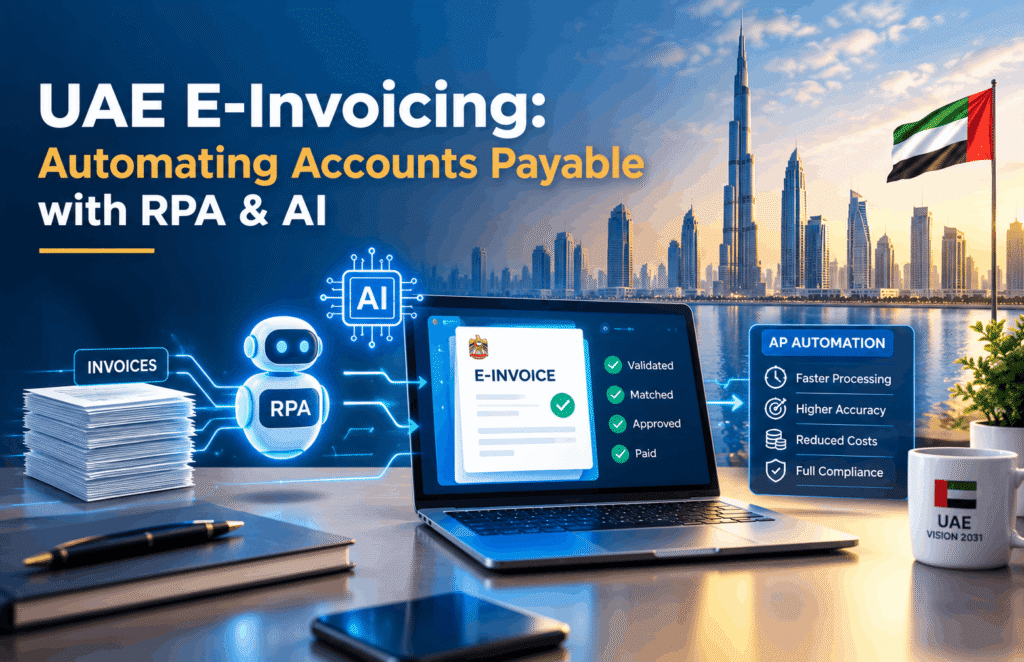
UAE E-Invoicing: Automating Accounts Payable with RPA & AI

The UAE’s e-invoicing system is transforming invoice processing through digitalisation, automation and transparency. By integrating RPA and AI with ERP and accounting systems, businesses can automate invoice receipt, validation, purchase-order matching, approval and payment processing. This reduces manual work, minimises errors and improves accounts payable efficiency. RPA and AI can manage high invoice volumes, identify duplicate invoices, detect unusual transactions and flag discrepancies. Automated workflows reduce bottlenecks and ensure timely processing. Beyond efficiency, automation strengthens VAT and compliance controls, reliable electronic records and audit trails. Businesses should review their systems, workflows, data and compliance controls to ensure readiness for digital invoicing. Automating Supplier Invoice Processing with RPA & AI  RPA automates receiving and processing supplier e-invoices, reducing manual data entry and streamlining the accounts payable workflow. RPA automates invoice checks, while AI identifies unusual transactions, improving accuracy, compliance and efficiency in invoice processing. AI helps detect duplicate invoices by comparing key invoice details, reducing payment errors and strengthening accounts payable controls. AI automates invoice matching with purchase orders and goods receipts, identifies discrepancies, and flags exceptions for review before payment. RPA automates invoice routing and approvals, while AI optimises workflows and reduces approval delays. Automation processes routine invoices and flags exceptions for human review, improving efficiency and reducing manual effort. Using AI for Supplier and Spend Analysis  Supplier performance & spending patterns Frequently purchased products or services Price variations & Cash-flow requirements Unusual transactions & Payment trends Processing bottlenecks Business Benefits of RPA & AI-Driven Invoice Processing  Less manual data entry and administrative workload. Faster & Better invoice processing & matching. Improved data accuracy & cash-flow visibility Improved audit trails & financial insight. Better VAT and compliance controls Reduced duplicate-payment  Faster approval workflows What Businesses Need to Evaluate ? Supplier invoice processes & purchase orders ERP, accounting & supplier data Approval workflows & VAT controls ASP integration & compliance requirements Data retention & audit trails RPA, AI & analytics opportunities Finance team roles and responsibilities Numerous changes are happening in workplaces. The enormous progress in using technology results in a high degree of automation, transparency and acceleration. In a global business hub where the use of technology is in full momentum, there is no choice but to adopt the changes for businesses to become successful in this era of constant change.​ GSPU Auditing, a dynamic Audit & Accounting firm with 20+ years of international experience, provides audit & assurance, accounting & financial, Tax & business consulting, company incorporation & management consultancy services, adopting a professional & friendly approach and caring about the success of our clients, holding an enviable reputation. Being the Best Auditing Firm & TAX Consultancy in the UAE, our well-known & Certified Accountants & auditors, who have international expertise as well as comprehensive knowledge of the local market, work hard with a strong moral commitment and gain the trust of our customers by providing professional services of high quality in an independent, objective and ethical manner, obeying Integrity and professionalism. Expert financial and compliance advice for business innovation, success and survival is a basic need for every business. We at GSPU prioritize time and quality in Financial, Accounting, Audit, Company Formation, Management and VAT services to help businesses to grow by making a clear strategy saving time & money by generating more revenue. Your Success, Our Passion. We, the Global Strategic Partners Union, always welcome your Business & Financial grievances as we make the work into service, and turn customers into friends & client relationships as business partnerships.

Tax

UAE DMTT and Pillar Two: Key Tax Implications for Multinational Groups

The UAE’s DMTT, effective from 1 January 2025, applies to qualifying multinational groups under the OECD Pillar Two framework, ensuring a minimum 15% effective tax rate. It generally covers groups meeting the €750 million revenue threshold and requires assessment of group structure, UAE entities, exemptions and ETR. Multinational groups should also review the impact of DMTT on UAE free zone structures, as a top-up tax may apply where the ETR is below 15%. How Does the 15% Minimum Tax Rate Apply?  Determine the Jurisdictional effective tax rate under the DMTT framework. Apply the required specific adjustments beyond standard Corporate Tax calculations in DMTT calculations. Review GloBE income/loss, covered taxes, deferred taxes, permanent differences, eligible exclusions and other substance-based key factors. Apply other relevant adjustments required under the GloBE rules. Recognise DMTT ETR Differences from the rate reflected in financial statements or standard Corporate Tax calculations. Key Compliance Requirements Under UAE DMTT Ensure accurate UAE ETR calculations in line with the GloBE framework. Accurate, consistent data across group entities for effective DMTT compliance. Maintain proper DMTT records to support compliance and facilitate audits. Ensure proper group-level coordination for accurate and timely DMTT compliance. Key DMTT Challenges for Businesses  Complex Tax Calculations Data Quality Issues Limited Internal Expertise Technology Limitations Constant Regulatory Developments DMTT Compliance: How Businesses Can Prepare ? Check DMTT Group Eligibility Evaluate the UAE Business Structure Calculate the UAE Effective Tax Rate Assess Data Availability and Quality Enhance Internal Tax Controls Reassess Existing Tax Structures Obtain Professional DMTT Guidance DMTT and the Future of UAE Tax Compliance The introduction of UAE DMTT adds new compliance requirements for multinational groups, requiring accurate tax data, ETR calculations, documentation, internal controls and cross-border coordination. Businesses should review their group structure and tax positions, strengthen reporting processes and prepare early for ongoing compliance. Professional tax and accounting support can help manage DMTT requirements effectively. Numerous changes are happening in workplaces. The enormous progress in using technology results in a high degree of automation, transparency and acceleration. In a global business hub where the use of technology is in full momentum, there is no choice but to adopt the changes for businesses to become successful in this era of constant change.​ GSPU Auditing, a dynamic Audit & Accounting firm with 20+ years of international experience, provides audit & assurance, accounting & financial, Tax & business consulting, company incorporation & management consultancy services, adopting a professional & friendly approach and caring about the success of our clients, holding an enviable reputation. Being the Best Auditing Firm & TAX Consultancy in the UAE, our well-known & Certified Accountants & auditors, who have international expertise as well as comprehensive knowledge of the local market, work hard with a strong moral commitment and gain the trust of our customers by providing professional services of high quality in an independent, objective and ethical manner, obeying Integrity and professionalism. Expert financial and compliance advice for business innovation, success and survival is a basic need for every business. We at GSPU prioritize time and quality in Financial, Accounting, Audit, Company Formation, Management and VAT services to help businesses to grow by making a clear strategy saving time & money by generating more revenue. Your Success, Our Passion. We, the Global Strategic Partners Union, always welcome your Business & Financial grievances as we make the work into service, and turn customers into friends & client relationships as business partnership

Finance

Strategic Accounting Services in UAE: Driving Compliance, Growth & Financial Excellence

UAE is enhancing its status as a global business hub, attracting a variety of entities while imposing stricter regulatory responsibilities in financial reporting, tax compliance, and corporate governance. Accounting now serves as a strategic business support function rather than merely bookkeeping. This guide examines the advancements in accounting services, the evolving regulatory landscape, and essential considerations for businesses in choosing an accounting partner.  Relevance of Accounting Services in 2026  In recent years, the UAE has enacted key regulatory reforms that impact business finance management, necessitating that accounting firms provide more than basic bookkeeping services. Modern businesses now seek professional advisory roles, making the choice of an accounting firm a critical business decision.  Assure continuous regulatory compliance   Facilitate corporate tax strategies   Optimize VAT management   Get ready for mandatory E-invoicing   Provide immediate financial reporting   Aid in strategic business expansion   Significant Regulatory Alterations Prompting Transformation in Accounting  Corporate Tax, introduced in 2023, is now essential for business planning. Companies need accounting firms to provide advice on tax planning, transfer pricing documentation, cross-border implications, permanent establishment matters, group structures, and restructuring strategies. Accounting professionals prioritize optimizing tax positions and ensuring compliance with UAE regulations beyond merely preparing tax returns.  VAT compliance has significantly evolved, with various industries applying it in distinct ways. Real estate, hospitality, healthcare, and technology face unique VAT treatments, highlighting the need for industry-specific expertise. A standardized approach is inadequate; businesses require accounting professionals who grasp the specific operational and regulatory challenges they encounter.  Mandatory PEPPOL-based e-invoicing will significantly impact businesses earning over AED 50 million, requiring compliance by January 2027. Early adopters will need 6–9 months to prepare, while smaller firms can learn from larger ones. E-invoicing improves compliance, invoice accuracy, processing efficiency, financial transparency, workflow automation, and overall productivity.  Appropriate Accounting Firm in UAE Technical Proficiency Responsive Communication Advanced Technical framework Industry-Specific Experience Statutory Monitoring That Is Predictive Accounting services in the UAE have evolved significantly due to changing regulations and digital innovation. The rise of Corporate Tax, VAT specialization, and e-invoicing necessitates that businesses assess accounting firms on compliance, technical expertise, technology use, industry knowledge, and communication. Selecting the right accounting partner is crucial for not just compliance, but also for navigating regulatory changes and enhancing financial performance for sustainable growth in Dubai’s competitive market.  Numerous changes are happening in workplaces. The enormous progress in using technology results in a high degree of automation, transparency and acceleration. In a global business hub where the use of technology is in full momentum, there is no choice but to adopt the changes for businesses to become successful in this era of constant change.​ GSPU Auditing, a dynamic Accounting firm with 20+ years of international experience, provides accounting & financial services, adopting a professional & friendly approach and caring about the success of our clients, holding an enviable reputation. Being the Best Auditing Firm & TAX Consultancy in the UAE, our well-known & Certified Accountants & auditors, who have international expertise as well as comprehensive knowledge of the local market, work hard with a strong moral commitment and gain the trust of our customers by providing professional services of high quality in an independent, objective and ethical manner, obeying Integrity and professionalism. Expert financial and compliance advice for business innovation, success and survival is a basic need for every business. We at GSPU prioritize time and quality in Financial & Accounting services to help businesses to grow by making a clear strategy saving time & money by generating more revenue. Your Success, Our Passion. We, the Global Strategic Partners Union, always welcome your Business & Financial grievances as we make the work into service, and turn customers into friends & client relationships as business partnerships.
Finance

Financial Accuracy Starts Here: The Value of Accounting System Analysis in the UAE

Running a business in the UAE involves navigating financial obligations like VAT and corporate taxes. Accurate financial records are essential for compliance and decision-making. A Professional Accounting System Analysis is crucial for identifying errors and compliance gaps and enhancing financial accuracy in accordance with IFRS standards. Given the rapidly changing regulations in the UAE, regular Accounting System Analysis is vital to avoid penalties and ensure effective operations. Strengthening Financial Stability with Accounting System Analysis  Regular Accounting System Analysis identifies minor bookkeeping errors, like duplicate or incorrect entries, preventing them from becoming major financial issues. Early detection ensures accurate reporting & compliance.  UAE Compliance is complex, and Accounting System Analysis is critical for adhering to VAT, Corporate Tax, IFRS standards, free zone reporting, and internal policies, thereby reducing the risk of fines and regulatory issues. Accounting system analysis verifies the correctness of financial data on revenue, expenses, profitability, assets, liabilities, and cash flow, which helps management make well-informed strategic decisions.  Weak financial controls elevates to unauthorized & fraud transactions , whereas an Accounting System Analysis detects irregular transactions, missing documentation, control flaws, segregation of tasks concerns, and illegal approvals, which improves accountability and lowers financial risks.   An Accounting System Analysis offers accurate information that supports budget preparation, cash flow forecasting, investment planning, and cost management, facilitating informed decisions for future growth.   What Does an Accounting System Analysis Do? Accounting system analysis includes the evaluation of daily bookkeeping practices, cash flow management and bank reconciliations, compliance with UAE regulations, assessment of internal controls, and the presentation of financial statements.  How the  Accounting System Analysis Process Works ? Step 1: Understand Your Business – Your business model , Accounting software , Financial workflows , Internal processes , Industry-specific requirements Step 2: Analyse Financial Records to assess – Accuracy , Completeness , Supporting documentation , Accounting treatments , Financial consistency Step 3: Identify Issues including – Accounting errors , Process gaps , Compliance concerns , Control weaknesses , Reporting inconsistencies Step 4: Provide Practical Recommendations on – Business size , Industry , Financial complexity , Existing accounting systems Key Outcomes of an  Accounting System Analysis Month-end closings that are not complete Supplier invoices that are missing Inappropriate VAT handling Significant discrepancies in reconciling Accounting entries that are redundant Transactions that lack accompanying documentation Classifications of expenses that are inconsistent Bank reconciliations that are delayed Inadequate approval processes Numerous changes are happening in workplaces. The enormous progress in using technology results in a high degree of automation, transparency and acceleration. In a global business hub where the use of technology is in full momentum, there is no choice but to adopt the changes for businesses to become successful in this era of constant change.​ GSPU Auditing, a dynamic Audit & Accounting firm with 18+ years of international experience in accounting & financial adopts a professional & friendly approach and caring about the success of our clients, holds an enviable reputation. Being the Best Accounting Firm in the UAE, our well-known & Certified Accountants & auditors, who have international expertise as well as comprehensive knowledge of the local market, work hard with a strong moral commitment and gain the trust of our customers by providing professional services of high quality in an independent, objective and ethical manner, obeying Integrity and professionalism. Expert financial and compliance advice for business innovation, success and survival is a basic need for every business. We at GSPU prioritize time and quality in Accounting services to help businesses to grow by making a clear strategy saving time & money by generating more revenue. Your Success, Our Passion.​ We, the Global Strategic Partners Union, always welcome your Business & Financial grievances as we make the work into service, and turn customers into friends & client relationships as business partnerships.

Business

Critical Business Valuation Rules in Dubai: Every CFO Must Understand in 2026

Business valuation in Dubai is essential for corporate tax compliance, transfer pricing governance, and financial reporting starting in 2026. Legislative changes have increased the importance of accurate valuations, especially for CFOs aiming to enhance tax outcomes and ensure regulatory compliance. Treating valuation as a continuous compliance process will strengthen companies’ risk management and financial reliability in a stricter regulatory environment.   Rising Significance of Business Valuation in 2026  Corporate tax has radically transformed the UAE’s financial landscape. Valuation now affects Corporate tax calculations , Real estate asset revaluations , Transfer pricing documentation , Related-party transactions , Investment property accounting , Financial reporting under IFRS , Business restructuring and succession planning. As compliance standards tighten, firms must ensure their values are accurate and backed by adequate documentation to avoid fines, tax adjustments, and increased regulatory scrutiny.  Significant Regulations Impacting 2026 Business Valuation One significant update for real estate developers is the FTA’s CTP009 clarification, which details transitional tax rules for Qualifying Immovable Property (QIP). Key changes include the application of project-level rules, separate property elections, a methodology for calculating excluded gains, and the mandatory use of authorised valuation professionals. This clarification is crucial, as it can reduce taxable gains before corporate tax is applied. However, inaccuracies in valuation or elections may lead to benefit denial. CFOs should review holdings, secure independent valuations, maintain proper documentation, and ensure compliance with election rules.  Ministerial Decision No. 173 of 2025 permits businesses using the fair value model for investment properties to claim depreciation deductions, enhancing tax optimization. It specifies eligibility requirements, annual depreciation limits, and deferred tax implications. CFOs are advised to reassess property portfolios, evaluate tax benefits, conduct updated valuations, and consider deferred tax effects before making decisions.   Transfer pricing compliance is essential under the UAE Corporate Tax Law, requiring adherence to the Arm’s Length Principle for related-party transactions. Key requirements include disclosures, Local and Master File preparation, Country-by-Country Reporting, and benchmarking studies. Valuation techniques apply to intellectual property, intercompany financing, and asset transfers. CFOs should conduct regular reviews, maintain benchmarking studies, prepare documentation, and establish internal controls for compliance.  The Growing Role of IFRS and Financial Reporting underscores the impact of financial reporting standards on valuation practices in the UAE, addressing key areas like asset impairment testing, fair value measurements, purchase price allocations, accounting for investment properties, and financial statement disclosures. The adoption of IFRS enhances transparency, consistency, and thorough documentation in these methodologies.   Business valuation in Dubai is crucial for corporate tax compliance, transfer pricing governance, and financial reporting starting in 2026. Legislative changes have heightened the need for accurate valuations, particularly for CFOs looking to improve tax outcomes and regulatory compliance. Companies that consider valuation a continuous compliance process will bolster their risk management and financial reliability in an increasingly stringent regulatory landscape.  Numerous changes are happening in workplaces.The enormous progress in using technology results in a high degree of automation, transparency and acceleration. In a global business hub where the use of technology is in full momentum, there is no choice, except to adopt the changes for businesses to become successful in this era of constant change. GSPU Auditing, a dynamic Audit & Accounting firm with 18+ years of international experience provides Business Valuation & business consulting services adopting a professional & friendly approach and caring about the success of our clients holding an enviable reputation. Being the Best Auditing Firm & TAX Consultancy in UAE, our well-known & Certified Accountants & Auditors who have international expertise as well as a comprehensive knowledge of the local market work hard with a strong moral commitment and gain the trust of our customers by providing professional services of high quality in an independent, objective and ethical manner obeying Integrity and professionalism. Expert financial and compliance advice for business innovation, success and survival is a basic need for every business. We at GSPU prioritize time and quality in Business Valuations to help businesses to grow by making a clear strategy saving time & money by generating more revenue. Your Success, Our Passion. We the Global Strategic Partners Union always welcome your Business & Financial grievances as we make the work into service, and turn customers into friends & client relationships as business partnerships.
Business

E-Invoicing Guidelines Version 1.1 (June 2026): Important Specifics UAE Businesses Need to Know

As the UAE moves towards a fully digital tax framework, the newly released UAE E-Invoicing Guidelines Version 1.1 (June 2026) do not introduce new compliance requirements but provide essential clarifications for businesses. Key topics include practical compliance, record keeping, audit preparation, and invoice treatment. These clarifications aim to eliminate ambiguity, facilitating smoother implementation of the e-invoicing system. The guidelines address issues such as storage flexibility, ASP responsibilities, audit trails, advance payments, and retention arrangements, thereby enhancing compliance readiness. Despite the absence of major changes, businesses are encouraged to review their systems and processes to ensure preparedness for future compliance obligations in the UAE’s e-invoicing landscape. Adaptable Storage Requirements The updated standards allow businesses to store electronic invoices and related records in any location or manner, including on-premises, cloud-based, or through third-party solutions, enabling them to utilize existing document management systems without major infrastructure changes. The records: Are securely maintained Stay accessible throughout the retention period. Can be quickly delivered to the Federal Tax Authority (FTA) upon request. Maintain the validity and integrity of the invoices. Responsibility Is Not Transferred via ASP Storage Delegation Companies can engage an ASP for invoice transmission and storage, but the taxpayer remains responsible for compliance. Thorough due diligence and clear contractual obligations are essential when selecting an ASP.If invoice storage is handled by a third party, companies still need to make sure that: Retention standards are fulfilled. Records are still available. Security guidelines are upheld. Regulatory requirements are met. Improved Audit Trail Parameters Companies must maintain documentation for the entire duration of electronic invoicing transactions to support regulatory inspections, tax audits, and compliance reviews, ensuring transparency through a strong audit trail. These documents could consist of: Logs of transactions Transmission records for invoices Verifications of receipts Time stamp processing System-produced acknowledgements Explanation of Advance Payments A tax invoice should be issued immediately upon receiving an advance payment, while the final invoice must reflect only the remaining balance after considering the advance. This process aids businesses in managing VAT reporting and prevents the duplication of taxable amounts, ensuring accurate tax treatment and invoice reconciliation. Current Retention Agreements May Persist Companies should continue their existing retention strategies and invoice amounts that are due. When contractually due payments are retained, they may be invoiced separately, simplifying administration and aligning invoicing rules with business practices. How Does This Impact Businesses? The June 2026 amendment focuses on implementation guidelines rather than introducing new duties, urging companies to review their current procedures for compliance with the updated specifications. Key evaluation aspects are : Policies for storing and retaining invoices Compliance obligations and service agreements with ASP Audit trail records and system functionality Invoice processes for advance payments. Retention payment management procedures. Numerous changes are happening in workplaces.The enormous progress in using technology results in a high degree of automation, transparency and acceleration. In a global business hub where the use of technology is in full momentum, there is no choice, except to adopt the changes for businesses to become successful in this era of constant change. GSPU Auditing, a dynamic Audit & Accounting firm with 18+ years of international experience provides audit & assurance, accounting & financial, Tax & business consulting, company incorporation & management consultancy services adopting a professional & friendly approach and caring about the success of our clients holding an enviable reputation. Being the Best Auditing Firm & TAX Consultancy in UAE, our well-known & Certified Accountants & Auditors who have international expertise as well as a comprehensive knowledge of the local market work hard with a strong moral commitment and gain the trust of our customers by providing professional services of high quality in an independent, objective and ethical manner obeying Integrity and professionalism. Expert financial and compliance advice for business innovation, success and survival is a basic need for every business. We at GSPU prioritize time and quality in Financial, Accounting, Audit, Company Formation, Management and VAT services to help businesses to grow by making a clear strategy saving time & money by generating more revenue. Your Success, Our Passion. We the Global Strategic Partners Union always welcome your Business & Financial grievances as we make the work into service, and turn customers into friends & client relationships as business partnerships.

Tax

UAE Corporate Tax & FamilyFoundations: A New Era of Clarity

As the UAE continues to solidify its position as a globally competitive financial hub, the Federal Tax Authority’s latest Corporate Tax Guide on Family Foundations (CTGFF1, May 2025) marks a significant milestone. This comprehensive document provides long- awaited clarity on the Corporate Tax treatment of Family Foundations, Trusts, and similar entities under Article 17 of the UAE Corporate Tax Law. What Is a Family Foundation? For Corporate Tax purposes, a Family Foundation isn’t defined by a specific legal form. Instead, it refers to a foundation, trust, or similar entity that meets specific conditions, mainly serving to manage and preserve family wealth across generations, without engaging in business activities. Entities that meet these criteria can apply to be treated as Unincorporated Partnerships, gaining fiscal transparency and thus avoiding Corporate Tax in their own right. This is a game-changer for estate planning and wealth structuring in the region. Conditions to Qualify To be treated as a Family Foundation under Article 17(1), entities must:1) Benefit natural persons or public benefit entities2) Primarily manage investments or savings3) Avoid business activities (as defined by the Law)4) Not be used for tax avoidance5) Follow special distribution rules when public benefit entities are involved Meeting these criteria allows Family Foundations and even their wholly owned subsidiaries to apply for fiscally transparent status—shifting the tax liability to the beneficiaries instead. Why This Matters Clarity for families, advisors, and trustees managing intergenerational wealth Alignment with international tax standards, while preserving local flexibility Opportunities for compliant structuring for foreign and local family entities Reinforcement of the UAE & competitive advantage in private wealth planning Key Takeaways for Practitioners Family Foundations, even foreign ones, may qualify if they have a nexus in the UAE. Unincorporated Trusts (like DIFC or ADGM trusts) are fiscally transparent by default. Multi-tier structures involving LLCs or SPVs may also benefit—if held by a qualifyingFamily Foundation. Let’s Discuss: How do you see these changes influencing family offices, wealth planners, or trustees operating in the UAE? Are your clients ready to restructure?  Contact us today for expert assistance.https://gspuuae.com/contact-us/

Tax

Withholding Tax in Saudi Arabia for UAE Companies Providing Services

Can UAE Companies Recover WHT from Saudi Arabia—Even If They Pay 0% Corporate Tax? As trade and cross-border services between the UAE and Saudi Arabia grow rapidly, many UAE-based service providers are encountering an unexpected deduction on their invoices: Withholding Tax (WHT) by their Saudi clients. This situation often leads to a pressing question: “If our company pays 0% corporate tax in the UAE, can we still recover the WHT deducted in Saudi Arabia?”The answer is yes. And here’s what you need to know. What Is Withholding Tax and Why Is It Deducted? Under Saudi Arabia’s tax regulations, any payment made by a Saudi-based company to a non- resident entity—even if the service is performed remotely—is subject to WHT, deducted at the source. Common WHT Rates in Saudi Arabia: 5% – Technical or consulting services 15% – Services provided by related parties 20% – Management fees 15% – Royalties and IP-related payments These deductions can significantly impact your profit margins—especially for startups and SMEs operating from the UAE, which historically had no corporate tax until recently. The UAE–KSA Double Taxation Agreement (DTA): Your Path to Relief Thanks to the Double Taxation Avoidance Agreement (DTAA) between the UAE and Saudi Arabia, businesses have two primary ways to reduce or recover WHT: 1. Benefit at Source – Apply in advance to avoid WHT deductions entirely 2. Refund Mechanism – Claim a refund of WHT already deducted through ZATCA (theSaudi Tax Authority) This post focuses on the refund process, especially relevant for UAE companies that either fall under the 0% UAE corporate tax threshold or qualify for Small Business Relief (SBR). Can You Claim a Refund If You Pay 0% Tax in the UAE? Let’s break this down with current UAE Corporate Tax rules: Scenario UAE Corporate Tax Payable? Foreign Tax Credit (FTC) Allowed? How to Apply for a WHT Refund from Saudi Arabia If WHT has already been deducted by your KSA client, here’s how to claim it back: Required Documents: UAE Tax Residency Certificate (TRC) – attested by the Saudi Embassy Form Q/7B – completed by the UAE company Form Q/7C – completed by the Saudi client Copy of WHT return and payment receipt from the client Authorization letter for the client to receive the refund (attested) Attested letter from the client stating that the refund has not been claimed elsewhere Submission Process: 1. The Saudi client submits all documents via the ZATCA online portal2. ZATCA reviews the application, and may conduct an audit 3. If approved, the refund is paid to the client’s bank account, who then transfers it to the UAE company Deadline: Refund claims must be submitted within 5 years of the WHT payment date. Tips for UAE Businesses Working with Saudi Clients Yes, you can recover WHT even if you’re taxed at 0% in the UAE Maintain strong coordination with your Saudi client—they must file the claim Keep thorough documentation: service agreements, TRC, WHT receipts, invoices For future contracts, consider applying for Benefit at Source to bypass WHT altogether Final Thoughts: Don’t Leave Money on the Table Withholding Tax doesn’t have to eat into your profits. UAE companies—regardless of their local tax liability—can fully recover WHT from Saudi Arabia by following the proper procedures under the Double Taxation Agreement. Whether you’re a consultant, marketing firm, tech provider, or freelancer, don’t overlook this opportunity to reclaim what you’ve earned. Need Help with WHT Refunds or Cross-Border Tax Planning? GSPU Tax consultancy can guide you through the refund process and ensure full compliance across borders. Let us help you maximize your profitability and avoid tax surprises. Contact us today for expert assistance.

Business

UAE BUSINESS SECTOR IN 2021

Even though during this Covid-19, UAE has taken its best actions to stabilize the sinking trade markets, there is a significant change in the customer tastes. Normalization of these changes may take a long time. But still after the Covid period will the economy be the same? The global concerts specify this normalization to take a longer time. Also the International Monetary Fund ( IMF), who initially stated a contraction of 2.7% for the GCC raised it to 7.6% in 2020, presently mentions that the business layouts should be adaptable to the customer requirements. Only this can prompt the cautious customers to spend and consume the deals. This is a matter of prior concern as it has impacts on economic health and job security. PRIME CONSIDERATIONS-: The worst contradiction is that the UAE economy is more dependable on the sectors which is most endangered to Covid-19 impression. Corona Virus has made its consequences on industrial markets, tourism and the economy.3/4Rth of the UAE revenue is produced from tourism, hospitality, and international trade sectors. And these sectors are adversely smacked down by Covid Pandemic. This is due to the World-Wide reduction of the creation of energy & its products. The current constraints have restricted the transportation and economical ventures.The present environment is the barrier for airline and hospitality services. Once all these are back to normal, the economy will have a huge rise to its earlier status, we can expect a V-shaped hike (as stated by Mr. Alabbar, Emaar Properties Chairman). OUR PERCEPTION Our Perception is that post Covid Businesses should be carried over only by the in-depth realization of the current situation. The mentioned revert will diversely affect the consumer delights in their consumption. As the current situation was an unpredictable scenario, Business leaders should be adaptable and vigilant to all the scenes. Proper guidance and planning is the key requirement for this.

Business

How To Form Your Company In Abu Dhabi Mainland

Earlier the formation of your business in Abu Dhabi was done by the Department of Economic Development ( an authorized group to assemble and initiate industry along with internal and external trade in the Emirate and prepare researches associated with industrial and commercial activities ) ,with the acknowledgement to the Abu Dhabi Chamber of Commerce & Industry. But now it is an easy-breezy procedure which tempts you to have the footprint of your business in UAE. Different types of Licenses issued under business set up in Abu Dhabi: Commercial License:Issued to owners of companies or establishments for practicing business  activities. Example: (general trading, construction, real estate, transportation, clinics, hospitals, etc).    Issuing Entity: Department of Economic Development Agricultural License:Issued to the owners of agricultural farms, animal production or sea products.     Issuing Entity: Department of Economic Development Professional License:Issued to artisans who personally practice a profession or craft for his own account, relying on his physical effort, or aided by some tools and equipment.     Issuing Entity: Department of Economic Development  Occupational License:Issued to professionals who rely on their abilities, mental and intellectual capabilities, talents and scientific capacities.      Issuing Entity: Department of Economic Development Benefits of forming your trade in Abu Dhabi: UAE welcomes your business with all the facilities of a developed country. Their support and guidance in all aspects is rich in commitment, quality and productivity. They comprises: Free venture set-up Supreme transport facilities. Genuine energies & services. Layout of the art & telecommunications. Civilized funding and assisting department. High-class class hotels, hospitals, schools, shops & Cosmopolitan lifestyle Chief international exhibition and conference arrangements. Qualified office and residential accommodation Our Assistance & Services: Analyze your business & advise the license and formalities to start your company in UAE. Supporting in structuring your trade. Assistance in opening your company & personal bank account. Compliance and Advisory support for VAT Registration Company Liquidation assistance. Guiding to prepare the application form for the DED. Perfect suggestions for selecting ware house/s or offices. Support for adding or deleting a shareholder or Director Getting your trade name approval, Initial Approval and security approval Preparing MOA of the firm. Accounting and Book Keeping services Assistance and advice for E – channel registration and obtaining the establishment card. Visa guidance for staffs & capitalists. Formation of additional documents for the company.(Eg: Certificate of Incumbency, Certificate of Good Standing, etc) Certifying the legal documents from authorized departments for the clients. Staff selection procedures. Perfect auditor appointment suggestion as it is a compliance criteria for having an auditor for free zone companies. Support in modifying the trade name. To expand or shrink firm’s stock holdings. Building business in UAE (Abu Dhabi) is the best decision to perfectly enlarge your profits. We, GSPU TAX CONSULTANCY, with our expert team will surely assist and guide you in all these aspects for the well being of your business and as a relief for your troubles.

Scroll to Top